
A DEXA scan (dual-energy X-ray absorptiometry, also called DXA) is an imaging test that measures what your body is made of: how much fat, muscle and bone you have, and where each one is. It uses two very low-dose X-ray beams, takes about ten minutes and is painless. It is the reference technique for measuring bone density and one of the most accurate ways to measure body composition.
Your scales tell you how much you weigh. A DEXA scan tells you what you’re made of.
Updated 18 November 2026 · Reviewed by Dr Alicia de Castro, of the TIVEN medical team
DEXA
The three senses coexist, which is why the term is confusing. In a hospital, “DEXA” usually means a bone density scan of the hip and spine. In body composition, it is a whole-body scan. The technique is the same; what changes is what you look at.
You lie on your back on a table while an arm passes slowly over you, from head to toe. Under the table, a source emits X-rays at two energy levels, one low and one high. Above you, a detector picks up what reaches the other side.
Each tissue slows the rays down differently. Bone slows them a lot. Fat, only a little. Muscle and the rest of the lean tissue sit in between. By comparing how each energy is slowed down, the scanner first separates bone from everything else and then fat from lean tissue.
The result is a point-by-point map of your body, which the software divides into regions: arms, legs, trunk, abdomen and hips.
Two energies, three tissues, one map of your body.
More than you might think. And almost none of it shows up on the scales or in the mirror.
How many kilos of fat you have and what percentage of your weight they make up.
How much fat there is in your arms, legs and trunk, and how it is split between abdomen and hips. Two people with the same percentage can carry it in very different places.
The fat that surrounds the organs inside your abdomen. You can’t pinch it or see it, and it can be high even if your weight is normal. DEXA estimates it from the image of your abdomen.
Everything that isn’t fat or bone: muscle, organs and water. It’s the closest estimate of your muscle that DEXA gives, although it isn’t exactly the same thing.
The lean mass in your limbs is almost all muscle. Divided by your height squared, it gives an index used to assess whether you have low muscle mass.
How much mineral your bones contain and, in a whole-body scan, how it compares with other people’s.
Because each side is measured separately, DEXA also shows differences between your right and left side, which is useful for athletes and for injury recovery.
It doesn’t measure your strength, fitness, glucose or cholesterol. Nor does it measure muscle directly, but lean mass. That’s why a good DEXA report is read together with your medical history and, if needed, other tests.
Your scales tell you how much you weigh. Not what you’re made of.
Each manufacturer lays out the report its own way, but almost all have the same parts. Here’s how to read them.
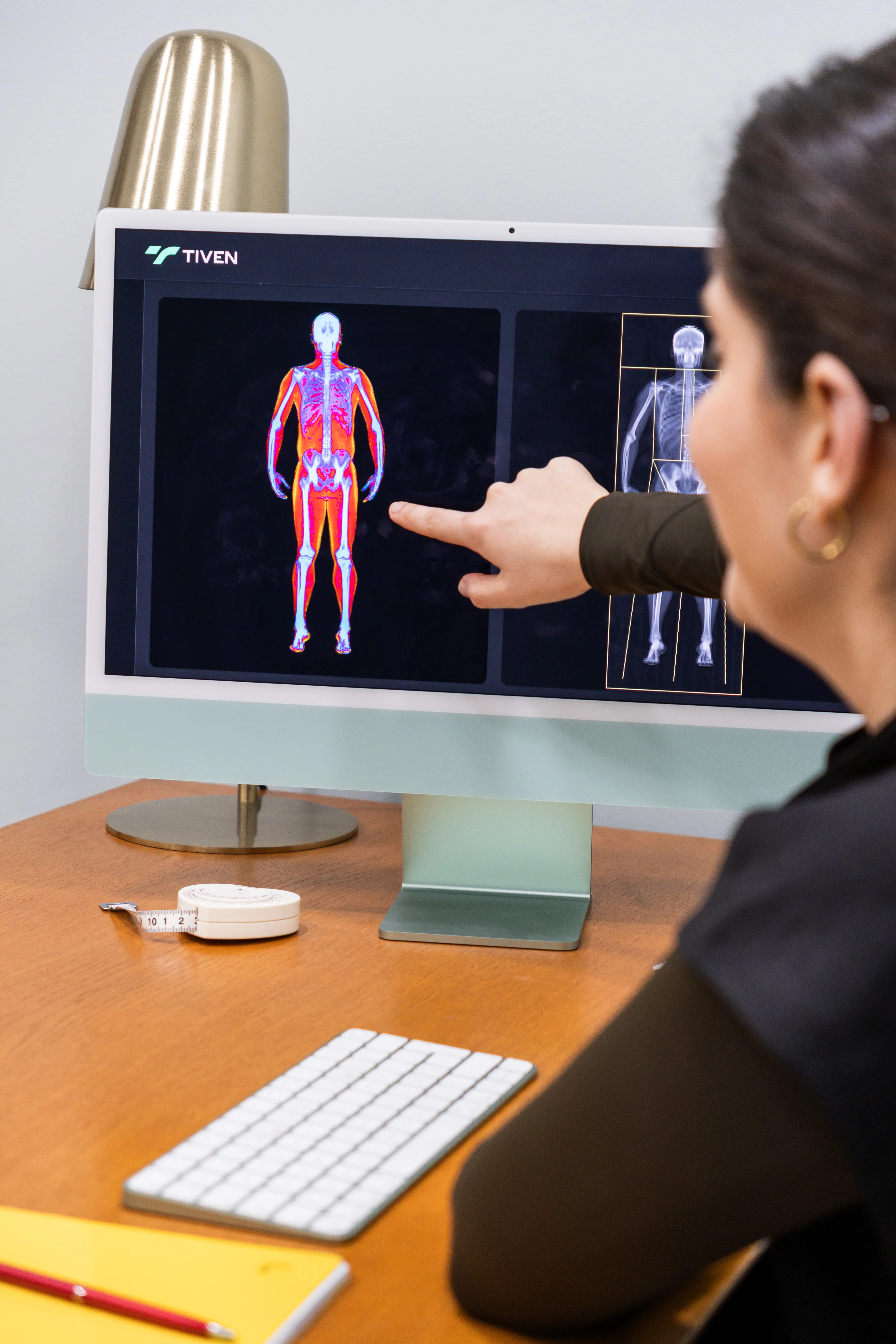
The most advanced digital report
Your body composition, visceral fat, muscle mass and bone density, all in one interactive report.
How fat, muscle and bone are distributed. Lighter or differently coloured areas usually indicate more fat.
Watch out: It’s an image to help you get your bearings, not to draw conclusions at a glance.
Fat, lean mass and bone for each arm, each leg and the trunk, in kilos.
Watch out: Look at the distribution and the differences between sides, not just the totals.
What share of your weight is fat.
Watch out: DEXA tends to give slightly higher percentages than bioimpedance scales. Don’t compare figures from different methods.
How much fat there is around your organs.
Watch out: Reference values vary from scanner to scanner and there is no single cut-off. Your doctor will tell you how to read yours.
Whether your fat tends to build up more in the abdomen (android) or in the hips and thighs (gynoid).
Watch out: A high value means more abdominal fat, which is the type most closely linked to cardiometabolic risk.
The muscle in your arms and legs relative to your height.
Watch out: It is one of the criteria used to assess sarcopenia: the European EWGSOP2 consensus defines low muscle mass as below 7.0 kg/m² in men and below 5.5 kg/m² in women. It is only one criterion: sarcopenia also takes strength and physical function into account.
How your bone, or your fat, compares with people of your age and sex.
Watch out: Population comparisons are a useful reference. Your main reference is you, over the years.
If you’ve been scanned before, the difference from your previous scan.
Watch out: A very small change may just be measurement noise.
If you have a bone density scan (of the hip and spine), the report includes two scores. The T-score compares your bone density with that of a healthy young adult of your sex. According to World Health Organization criteria, −1 or above is considered normal; between −1 and −2.5, low bone density (osteopenia); and −2.5 or below, osteoporosis. The Z-score compares you with people of your age and sex, and is the one used for young people and for women before menopause.
These criteria apply to hip and spine densitometry, not to whole-body scans for body composition. If you see a T-score on your whole-body report, discuss it with your doctor before drawing any conclusions.
A DEXA report has a lot of numbers. The ones that matter for you depend on your age, your medical history and your goal. That’s why it’s best to read it with a healthcare professional.
Both are done with the same type of scanner. But they answer different questions.
If you want to know whether your bones are fragile, what you need is a hip and spine densitometry, requested by your doctor. If you want to know how much fat and muscle you have, and where, what you need is a whole-body DEXA scan. The whole-body scan also gives a bone measurement, useful for tracking it over the years, but it doesn’t replace densitometry when that is indicated.
There are many ways to estimate what your body is made of. Each one is useful for something. The difference lies in what they can see and how precisely.
Swipe the table to see all the columns →
Bioimpedance and DEXA give results that point in the same direction, but they are not interchangeable: studies comparing them find differences of several points in body fat percentage. Scales are fine to get your bearings. If you want to make decisions with precise, comparable data, DEXA is the most practical reference.
Scales or bioimpedance: fine to get your bearings. DEXA: to make decisions.
Yes. It uses X-rays, but at a very low dose: roughly what you receive naturally in a day.
Our scanner, a Hologic Horizon Wi, performs a whole-body scan with a skin dose of 0.015 mGy, according to the manufacturer’s specifications. The effective dose, the one used to compare tests with each other, is lower still.
A whole-body DEXA scan on modern equipment gives a dose of a few microsieverts, similar to a dental X-ray and lower than the natural radiation we all receive in a day. A chest X-ray is several times more, and a CT scan hundreds of times more.
It doesn’t hurt, there’s no injection and it’s silent. You just need to lie still for a few minutes.
Prostheses, implants and other metal objects inside the body don’t prevent the scan, but they affect the reading of that area. Let us know before your scan.
Preparation is simple. What matters is that it’s always the same, so your scans can be compared.
Food and drink in your stomach count as lean mass.
No more, no less: hydration changes lean mass.
no zips, metal buttons or underwires. Remove any jewellery, watches and piercings you can.
with your arms by your sides. The person doing the scan will position you correctly.
while the scanner arm passes over you. You can breathe normally.
What matters comes next: understanding it with a healthcare professional.
If you’re going to repeat the scan, try to do it at the same time of day, in the same conditions and at the same centre.
It depends on what you want to see. Each tissue changes at its own pace. Decide with a healthcare professional.
Changes in fat and muscle with a training or nutrition plan
How your body changes over the years
How your bones change
For anyone who wants to know what their body is made of. And especially at these moments.
It depends on the centre and what’s included: just the scan, or also the medical interpretation and the report. At TIVEN, a scan with whole-body DEXA, medical assessment, medical consultation and a digital report costs €149.95 in Majadahonda (Madrid), and less per scan with the two- or four-scan packs.
DEXA uses X-rays, so health regulations require the test to be medically justified. At TIVEN you don’t need to bring a prescription: every scan starts with a medical assessment in which we check that it’s suitable for you.
Bone densitometry is, when your doctor requests it because of a risk of osteoporosis. Whole-body DEXA for body composition is not usually included and is done at private centres.
They measure different things with different precision. Bioimpedance is convenient and useful for seeing trends at home. DEXA is more accurate, separates fat, muscle and bone by region and measures visceral fat. Don’t compare figures from one method with the other.
With caution. Different scanners can give slightly different figures for the same person. To track your progress, it’s best to always be scanned on the same machine.
Yes. Metal isn’t a problem for the test, but it affects the reading of the area where it is. Let us know before your scan so we can take it into account when interpreting the report.
Yes. Breastfeeding doesn’t prevent you from having a DEXA scan.
They’re the same thing. Both stand for dual-energy X-ray absorptiometry. Both are in use; DXA is more common in medical settings and DEXA outside them.
At our clinic in Majadahonda (Madrid). From €149.95.
